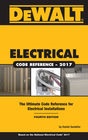
Product Benefits: - Carefully updated based on the most recent industry standards and requirements, the Fourth Edition of this best-selling text in the DEWALT® Code Reference Series reflects the National Electrical Code® 2017, National Fire Alarm and Signaling Code 2016, and International Residential Code® 2015.
- The text features updated guidelines based on the latest codes governing residential electrical work, including new requirements related to AFCI and GFCI, receptacle placement requirements, and branch circuits.
- Easy-to-follow diagrams break down complicated installations so readers can proceed step by step without getting overwhelmed or going astray.
- A reader-friendly writing style, frequent use of bullet lists, and visually appealing graphics and illustrations help readers master even complex material more readily--and apply their knowledge with confidence on the job.
- The text includes more than 80 pages of full-color, 3D illustrations; code violations; installation concerns; and prominent code references.
- Laminated covers and pages resist tearing, water, and oil, enabling this durable text to stand up to the demands of years of use as an on-the-job reference.
- Spiral binding allows the book to lie flat when opened, allowing for easy reference and convenient access on the job
Table of Contents: 1. General Terms and Definitions.
2. Basic Electrical Equipment.
Part I: RECEPTACLE REQUIREMENTS.
3. Permissible Receptacle Types for Branch Circuits.
Part II: RECEPTACLE TERMINALS.
4. Types of Terminals.
Part III: COMMON WIRING METHODS.
5. 1-Pole Switch.
6. 3-Way Switch.
7. 4-Way Switch.
8. 120-Volt Receptacle.
9. 120-Volt GFCI Receptacle.
10. 4-Wire, 240-Volt Receptacle.
11. Lighting Fixture.
12. Ceiling Fan with Light.
Part IV: SIZING BRANCH CIRCUITS.
13. Common Cable Types for Various Circuits.
14. Overcurrent Protection.
Part V: BASIC WIRING REQUIREMENTS AND TECHNIQUES.
15. Cables and Outlet Boxes Installations.
16. Roughing in Receptacle Outlets.
17. Standard Mounting Heights.
18. Lockout Provisions and Grounding.
Part VI: BOX FILL.
19. Typical Calculations.
20. Requirements.
Part VII: TEMPORARY SERVICE.
21. Overhead.
22. Underground.
Part VIII: SMOKE DETECTORS.
23. Residential Area Requirements.
24. Wiring Method.
25. Smooth Ceiling.
26. Placement.
Part IX: BEDROOM.
27. Layout.
28. Clothes Closet.
Part X: KITCHEN, EATING AREA AND DINING ROOM.
29. Layout.
30. Appliances – Ranges, Rangehood and Microwave.
31. Appliances – Dishwasher and Disposal.
Part XI: LIVING ROOM AND BONUS ROOM.
32. Layout.
33. Wetbar and Track Lighting.
Part XII: HALLWAY AND STAIRWELL.
Part XIII: LAUNDRY ROOM.
Part XIV: BATHROOM.
34. Typical Bathroom.
35. Hydromassage Bathtub.
Part XV: GARAGE.
Part XVI: UNFINISHED BASEMENT.
Part XVII: STORAGE AREA.
Part XVIII: OUTSIDE LIGHTING AND RECEPTACLES.
Part XIX: CRAWL SPACE.
Part XX: HVAC.
36. Inside Equipment.
37. Outside Equipment.
38.Conductor Sizing.
39. Air Handlers.
40. Condensing Units.
41. Package Units.
Part XXI: WORK SPACE.
Part XXII: FEEDERS AND SERVICES.
42. Conductor Sizing.
43. Subpanels.
44. Service Equipment.
45. Underground Raceways.
46. Overhead Services.
Part XXIII: SERVICE GROUNDING.
47. Grounding Electrode Conductors.
48. Rebar in Footer.
49. Metallic Water Piping.
50. Ground Rods.
Part XXIV: DETACHED BUILDINGS.
51. Detached Buildings.
52. Panels.
Part XXV: LOAD CALCULATIONS.
Part XXVI: USEFUL FORMULAS.
53. Ohm's Law.
54. Voltage Drop.
55. Formulas, Common Symbols and Abbreviations. |